> For the complete documentation index, see [llms.txt](https://shai-deshe.gitbook.io/understanding-blockdags-and-ghostdag/llms.txt). Markdown versions of documentation pages are available by appending `.md` to page URLs; this page is available as [Markdown](https://shai-deshe.gitbook.io/understanding-blockdags-and-ghostdag/part-1-blockchains-and-blockdags/chapter-1-bft-vs.-pow/merged-mining-and-multi-mining.md).
# Merged Mining and Multi-Mining
This segment is in a **pre-alpha** phase. None of what you read below is guaranteed to be correct in any way or be a part of the final product. Read with extreme caution or come back later.
***
*Merged mining* is a technique that allows a *primary* PoW chain (typically a small chain) to piggyback on the mining efforts of an *auxiliary* chain (typically a large chain, most commonly Bitcoin). The idea is to accept attempts the main chain. Since auxiliary miners are already doing this work anyway, they get to participate in the main chain "for free". This benefits both chains, as mining the main chain becomes more profitable.
On paper, this seems like a great idea, but in practice, it has limitations and even risks.
My gratitude to Quai network for sponsoring this segment of the book
Merged mining was first introduced by [Namecoin](https://www.namecoin.org/), a project that launched in 2011 to create a decentralized database of maintainable, consistent cryptographic identities. While the utility of Namecoin is worthy of a discussion, it seems that the most impactful observation they made is that *the same work can secure two chains*. It is very simple, on a technical level, to use byproducts of Bitcoin mining as valid Namecoin work. However, this decision arguably played a significant role in Namecoin's decline, as the network's security is overly reliant on an external source, which also had consequences for decentralization.
Future incarnations of merged mining proposed a more holistic approach called *multi-mining*, allowing the same chain to be mined in *several different ways*, limiting the consequences of merged mining.
In this section, after explaining in more detail how merged mining works, we consider its consequences for the main chain.
## The Pioneer — Bitcoin AuxPoW in Namecoin
We start with the simplest form of merged mining: Namecoin's original approach. We need a way for the main chain to accept work from auxiliary chain miners without interfering with their auxiliary chain mining. Such a form of mining is often called *auxiliary-proof-of-work* (AuxPoW).
Following the reasoning for how [regular PoW works](/understanding-blockdags-and-ghostdag/part-1-blockchains-and-blockdags/chapter-1-bft-vs.-pow/how-pow-works.md), we find some issues that need to be considered:
* The difficulty target in the header comes from the aux chain (so we call it $$T\_\text{aux}$$), but we need to maintain a separate difficulty target for the primary chain $$T\_\text{prim}$$.
* The Merkle transaction root couples the header to the *auxiliary* block data. We also need to couple it to the main chain data somehow.
That's not hard to accomplish, but it requires some attention to detail. Working through this is a good exercise in applying the principles we learned so far. I will explain specifically how Namecoin's AuxPoW is implemented. Most forms of AuxPoW are slight variations, adapted to the fine structure of the primary and auxiliary chain as needed.
### Merkle Tree Huggers
Recall that to couple the block data to the block header, Bitcoin headers contain a [Merkle transaction root](/understanding-blockdags-and-ghostdag/supplementary-material/computer-science/page-3/merkle-trees.md) (MTR). This Merkle root seems to be a solution to all our problems: you can couple any arbitrary data $$d$$ to the block header by adding a new leaf with the value $$\mathsf{H}(d)$$, and attach the corresponding Merkle proof $$P(d)$$ to the data. When validating the data $$(d,P(d))$$, add a step for checking that the Merkle proof goes through with respect to MTR.
This all sounds like simple stuff, until we realize that *we can't* add leaves to the transaction Merkle tree. If we try to, we make the block invalid! Recall that one step of validating a Bitcoin block is *recomputing* the MTR from the transaction and checking that it matches the MTR written in the header. But if we added additional leaves, then we modified the MTR!
Fortunately, there's a standard solution for that: embed the information you need *inside* a transaction. That way, the standard MTR computation automatically couples the header to your data. But what transaction should we use? In Bitcoin, the first transaction in each block is a special transaction called the *coinbase transaction*, which miners use to claim the block rewards and fees. Since miners must create a coinbase transaction (or relinquish their reward) anyway, it makes sense to embed the data in it.
### The Bitcoin AuxPoW Recipe
The previous section gives us enough to put together a recipe for converting any PoW chain into a Bitcoin AuxPoW chain. There are other recipes, but they are all very similar to this one.
Consider a standard PoW chain. A new incoming block $$B$$ is comprised of two parts: $$B\_\text{header}$$ and $$B\_\text{data}$$. We keep the standard structural assumptions: validating the validity of the chain only requires examining the headers, and given $$B\_\text{data}$$, we can validate that it indeed contains the data expected by $$B\_\text{header}$$. In particular, we expect $$B\_\text{header}$$ to contain a difficulty target $$T\_\text{prim}$$. We don't particularly care how the chain works. We only presume that it follows this general structure.
To convert it into a Bitcoin AuxPoW, we redefine the header to be an appropriately cooked-up *Bitcoin* header, and attach the original *header* to the block *data*, along with some useful auxiliary data. Let's flesh it out.
The AuxPoW header is a *Bitcoin* header $$B\_\text{aux}$$, with a payload $$P$$ in its coinbase transaction. The AuxPoW block *data* contains the following information:
* The original data $$B\_\text{data}$$ *and* the original header $$B\_\text{header}$$
* The coinbase transaction (which has $$P$$ embedded into it)
* A Merkle proof for the Bitcoin coinbase transaction
When validating a block, we check:
* $$B\_\text{aux}$$ has the *semantics* of a valid Bitcoin header. By "semantics," I mean that we check it has the expected structure, but skip any contextual texts. For example, we check that the header has a pointer to a parent block, but we don't check if that block actually exists. We check that the header has an MTR, but we don't retrieve the Bitcoin block.
* $$\textsf{H}\left(B\_\text{aux}\right) < T\_\text{prim}$$. Note that we use the *primary chain* difficulty target on the *auxiliary* chain header
* The validity of $$P$$, using the coinbase Merkle proof
* Any remaining validity test from the original chain
{% hint style="info" %}
The approach embodied in this recipe is actually a bit outdated. There is a well-hidden trade-off between *Bitcoin semantics* and *header-only validation*.
Bitcoin semantics means that the auxiliary chain header has identical semantics to a Bitcoin header, and any additional information required for verification is appended to the block *data*. In the early days of Namecoin, this was considered a virtue, as most blockchain-related code was Bitcoin-specialized, so maintaining the semantics made reusability much easier.
Header-only validation unsurprisingly means that the block headers are sufficient on their own to validate the consensus, and you only need the data to access transactions.
As the landscape progressed, and more major projects and ideas started to saturate the market, Bitcoin semantics became less and less relevant. On the other hand, SPV proofs, NiPoPoWs, and other technologies made header-only validation increasingly useful.
I maintain the Namecoin version for ease of presentation, but modern chains largely prefer header-based consensus over Bitcoin semantics. Modifying the recipe to reverse the trade-off (give up Bitcoin semantics for header-only verification) is straightforward and remains as an exercise for the reader.
{% endhint %}
{% hint style="info" %}
This solution assumes there is only one primary chain. If several primary chains use this recipe, each block can merge mine into only *one* of them. It is possible to extend this approach to allow *each* block to merge mine into *many* primary chains, but some subtle tricks are required to keep everything coordinated. The rough idea is to use a *huge* but *mostly empty* Merkle tree of commitments (the professional term is a *sparse Merkle tree*), and use the header data to choose a leaf for each merged chain in an unpredictable manner. That way, we naturally avoid different primary chains accidentally using the same leaf, without requiring any coordination.
I guide the reader through this construction in the exercises. \[No I don't lol, but I will get to this when I rewrite the exercises section]
{% endhint %}
## Problems and Limitations
As stated at the top of this section, merged mining is not a magic solution for obtaining Bitcoin-level security. Two main divergences merit a discussion.
### Reorg Security
It is tempting to imagine the reorg security of the auxiliary chain protecting the main chain from reorgs, but it is not the case. To see this, recall that the auxiliary chain does not validate anything regarding the primary chain. In fact, it is impossible to tell from the auxiliary chain header whether a block was merge-mined at all.
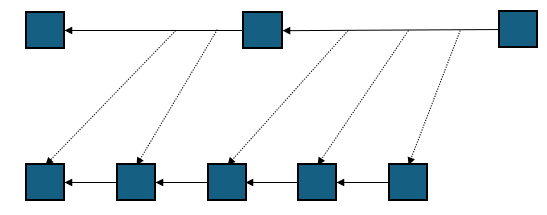
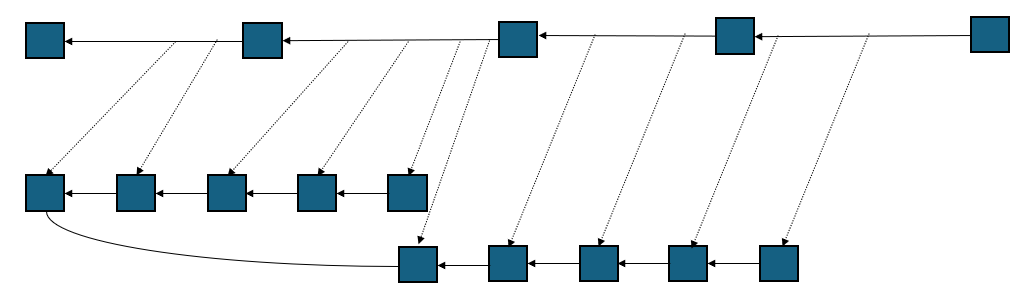
This does not prevent a situation where the auxiliary chain first merge-mines the primary chain like so:
but then decide to pivot to another branch, like so:
The key feature to notice here is that the primary chain was reorged, while the auxiliary chain wasn't. You can ask why a miner would do such a thing. As we will discuss in depth in the next chapter, a more appropriate question when discussing security is why the miner *wouldn't*. We can't know what could motivate anyone to interfere with a chain. We can only reason what they have to lose if they do interfere, and hope it's enough to prevent any monkey business.
When considering the auxiliary chain, there is a clear answer: reorg attempts directly decrease expected profit. But is it the case for the primary chain too? As the picture above shows, not so much.
The key here is that if mining is practically free, then attacks are practically free. It could be that 10% of the auxiliary coin miners actually merge their mining with the primary coin. It could also be that the very next day, the primary coin X community got on the wrong side of a 20% miner of the auxiliary chain. If merged mining is "for free", then the 20% miner has no incentive *not to* use that free mining for grievance attacks.
### Incentive Alignment
We have not discussed incentives formally yet, as this discussion is more natural in the context of the next chapter. On an intuitive level, incentive alignment means that the way we want miners to behave aligns with how they will want to behave under some condition (most commonly, how a miner that seeks to maximize their profit will behave if a majority of the miners are honest).
Even in the "simplest" case of Bitcoin, alignments are a highly delicate subject. But we don't need to thoroughly understand the alignments in depth to notice that the primary chain doesn't inherit them.
One example that pops to mind is transaction fees. We usually assume that miners are incentivized to include transactions in their blocks. But even if this does hold for the auxiliary chain, merged mining can skew this alignment for the primary chain.
While it is true that merged mining is "free" in terms of computational resources, it still presents an engineering challenge with non-negligible friction. Typically, the auxiliary chain is not active enough to support an active fee market. In this situation, auxiliary miners have no reason to maintain a full node of the primary chain and validate transactions, when just tracking the headers is enough to merge-mine *empty* blocks. The upshot is that most of the chain is unoccupied, making censorship much easier. In practice, projects try to overcome this by providing merged mining pools, but this has the price of sharply centralizing the mining.